Your brand no longer lives in one place. It shows up on your main website, on landing pages built for ads, on location or product pages, in your checkout, your emails and your social profiles. When all of those look and sound like the same company, customers trust you a little more at every step. When they don’t — mismatched logos, three shades of “your” blue, buttons that behave differently on every page — people notice, even if they can’t say why. That quiet inconsistency is costing you sales and slowing your team down. A design system is how you fix it.
What is a design system, and why does brand consistency matter? A design system is one shared, reusable kit — your colors, fonts, logos, buttons and layout rules — that every page and campaign is built from, so your brand looks and works the same everywhere. It matters because consistent brands are trusted more, remembered more, and convert better: research links consistent brand presentation to revenue increases of up to 23%.
Your web presence is now a dozen surfaces, not one page
A decade ago, “your website” meant a handful of pages a designer laid out once. Today the average business runs a sprawling presence: a homepage, service and product pages, seasonal landing pages, a blog, a booking or checkout flow, maybe a customer portal or app — plus everything customers see off-site, from Google listings to social posts. Each of those was probably built at a different time, by a different person or tool. Left unmanaged, they drift apart. The header on your landing page doesn’t match the one on your homepage. The “Buy now” button is teal in one place and navy in another. The logo has three slightly different versions floating around. None of it is dramatic on its own, but together it tells a visitor your business is a little disorganized — right at the moment you’re asking them to trust you with a payment.
What inconsistency actually costs you
Does brand consistency really affect revenue? Yes, measurably. A widely cited study by Lucidpress (now Marq) found that consistent presentation of a brand across all channels can raise revenue by up to 23% — and a later edition of the research put the upper figure as high as 33%. The logic is simple: consistency builds recognition, recognition builds trust, and trust is what turns a visitor into a buyer.
The pattern holds at the top of the market, too. In a landmark five-year study of 300 public companies, McKinsey found that the businesses with the strongest design practices grew revenue 32% faster than their industry peers and delivered 56% higher total returns to shareholders. Design here isn’t decoration — it’s the discipline of showing up consistently and clearly everywhere a customer meets you. The chart below shows just how wide that gap is.
There’s a hidden cost, too, and it’s internal. Without a shared system, your team rebuilds the same things over and over — a new landing page means re-picking colors, re-styling buttons, guessing which logo file is current. That’s slow, and slow is expensive.
What a design system actually is (in plain language)
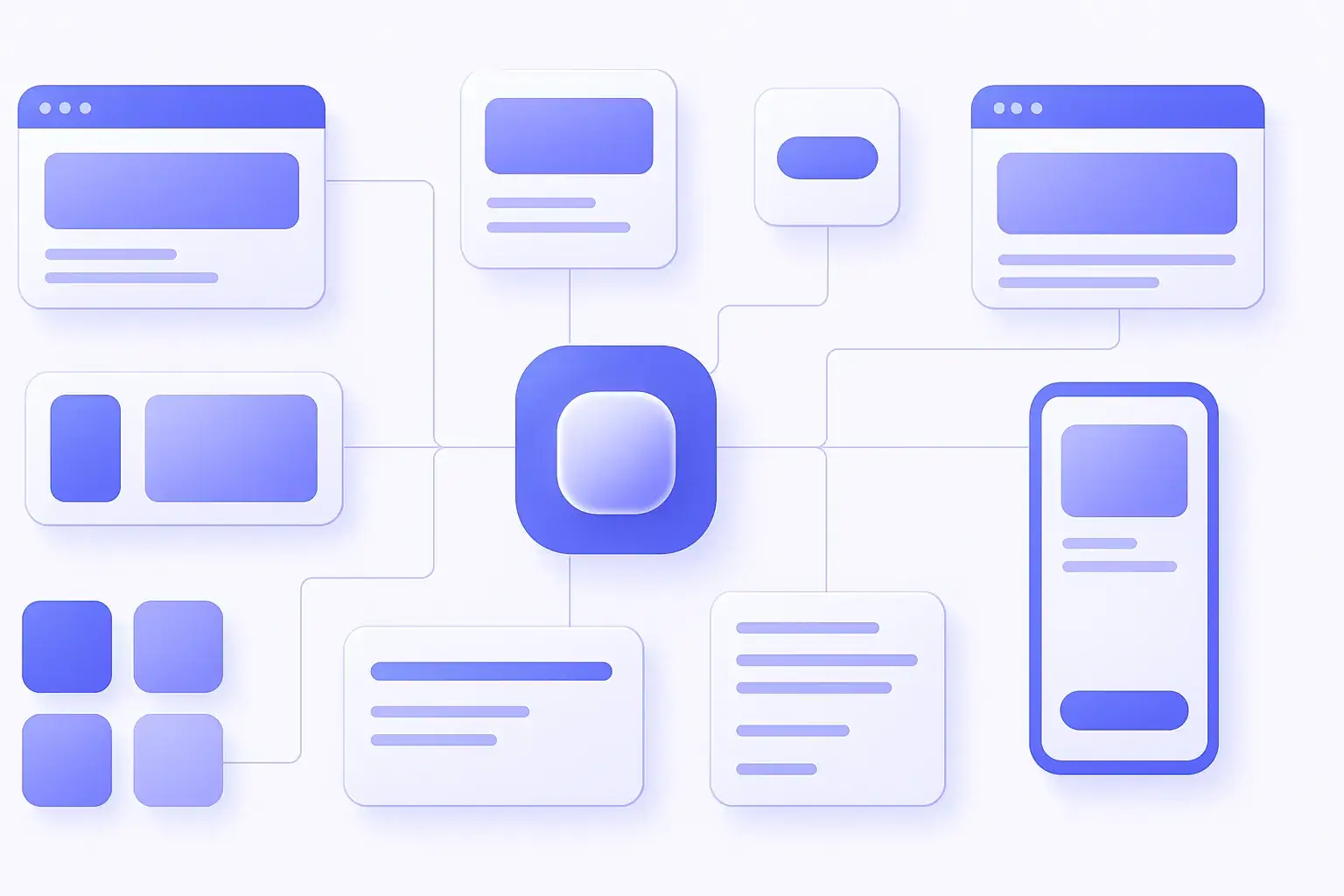
Think of a design system as the single source of truth for how your brand looks and behaves online. It usually includes:
- Brand basics — your exact colors, fonts, logo files and the rules for using them (which blue, which spacing, which version of the logo).
- Reusable components — pre-built buttons, headers, forms, cards and menus that already look right, so nothing gets rebuilt from scratch.
- Content and voice rules — how you write headlines, calls to action and product descriptions so the words match the look.
- One place to update — change the button style or brand color once, and every page that uses it updates too.
You don’t need to be a design agency to benefit. Even a small business gets the same three wins: every page looks like it belongs to the same company, new pages ship faster, and updates stop being a game of hunt-the-old-logo.
The payoff: consistency and speed, at the same time
The best part of a design system is that it makes your brand both more consistent and faster to work with — you don’t have to trade one for the other. In a controlled test by the web studio Sparkbox, teams building the same page with a ready-made design system finished it about 47% faster than teams coding it from scratch (a median of two hours versus more than four). Multiply that across every landing page, promotion and seasonal campaign you launch in a year, and the system pays for itself in saved time alone — before you count the revenue lift from looking like a brand customers recognize and trust.
How PLAZA builds brand consistency into your web presence
Most business owners don’t have the time — or the desire — to police fonts and button colors across a dozen pages. That’s the job PLAZA takes off your plate. We build and maintain a design system for your whole web presence: one brand kit, a library of reusable components, and clear rules, all applied consistently across your site, landing pages and campaigns. When it’s time to launch something new, it already matches. When your brand evolves, we update it in one place and it flows everywhere. You get a web presence that looks like one confident company from the first click to the checkout — and a team that stops reinventing the same page.
See how PLAZA keeps your brand consistent across your web presence, or talk to us about your site — we’ll show you honestly where your brand is drifting today.
Frequently asked questions
What is a design system?
A design system is one shared, reusable kit — your colors, fonts, logos, buttons and layout rules — that every page and campaign is built from, so your brand looks and behaves the same everywhere. It’s the single source of truth for your online look and feel.
Does brand consistency really increase revenue?
Yes. Research by Lucidpress (now Marq) links consistent brand presentation across channels to revenue increases of up to 23%, with a later study putting the figure as high as 33%. Consistency builds the recognition and trust that turn visitors into buyers.
Do small businesses need a design system?
Yes — arguably more than big ones, because small teams can’t afford wasted time or lost trust. Even a lightweight system means every page looks like the same company, new pages ship faster, and updates happen in one place instead of ten.
Is a design system just a logo and a color palette?
No. A logo and palette are the starting point. A working design system also includes reusable components (buttons, forms, headers), content and voice rules, and a single place to update them — so consistency is built in, not policed by hand.
How does a design system save time?
Instead of rebuilding buttons, headers and layouts for every new page, your team assembles them from a ready-made library. In one controlled test, that made a page about 47% faster to build than coding it from scratch (Sparkbox).
Sources
- Lucidpress / Marq, State of Brand Consistency (consistent presentation increases revenue up to 23%); 2019 update reported up to 33% via PR Newswire.
- McKinsey, The Business Value of Design (McKinsey Design Index): +32% revenue growth and +56% total shareholder returns vs. peers over five years.
- Sparkbox, The Value of Design Systems Study (same page ~47% faster to build with a design system).